

Buying a Boat- Key Things to Know Part 1
The Unspoken Fact
Not enough brokers acknowledge this fact but everything with a boat is a compromise.
Now while that may sound like an unattractive thing to say, especially when being out on the water is about having a great time and living life to the max, but it is true. The key is to understand how this compromises work in relation to each other and using them to help filter out the boats that won’t work for you. A compromise can be everything from storage space, right up to how much money you spend to purchase a boat.
Here are some of the things that we think you should be thinking about when you buy a boat.
The Hull Profile
This is arguably one of the most fundamental choices that a boat buyer needs to make. This choice will dictate much of any boat that you purchase. The good news is that there are 3 main types, plaining, semi-displacement and displacement
Plaining
This is the fastest of the 3 that we are looking into. This type of hull is designed to be slippery in the water and to be most efficient at higher speeds. They use the water resistance in its favour to provide responsive handling
Pros:
- You can go faster
- Often have a sportier look
Cons
- Use more fuel
- Not efficient until you get on the plain
- Poorer handling at slow speeds
- Need calmer waters to work best
- Reduces storage space
Displacement
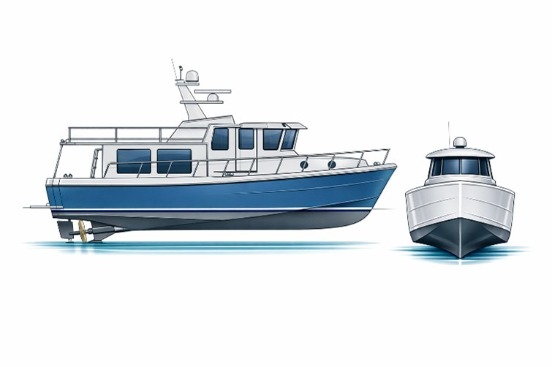
Displacement hulls are the slowest of the hull types. This type of hull works by pushing water out of the way. This shape of hull typically offers the most internal space.
Pros:
- Moves smoothly through water
- Fuel efficient at lower seeds
- Offers the most internal space
- More resilient in rougher water
- Very good directional stability
Cons
- Limited top speed (restricted by hull speed)
- Can have a larger draft
Semi-Displacement
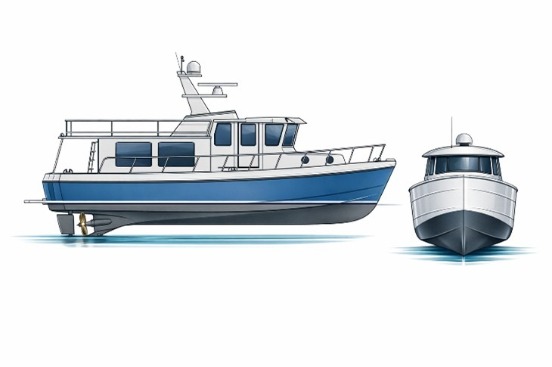
A semi-displacement hull offers features of both plaining and displacement hulls. It does have a smaller plane to get up on but also has a larger hull provide, which allows good directional stability at slower speeds and good options accommodations and storage space.
Pros:
- Can move efficiently at low speeds
- Can partially plane at higher speeds
- Balance of speed, stability and efficiency
Cons
- Slower than a planning hull
- Less efficient as a displacement hull
- It is a compromise between two hull types
The Hull Material
This is something that is often overlooked but the composition of the hull does actually matter it isn’t something that need to much time spending on, but it is work bearing in mind because you need to look after then differently. Where you use the boat also matters. The three that are most common are glass reinforced plastic (GRP), Steel and aluminium.
GRP is arguably the easiest to look after. It will still take on moisture and can suffer from a thing called osmosis. This is where water gets into small air pockets in the GRP and bubbles start to form. If the moisture gets too high, or osmosis occurs, the boat will need some time out of the water and for the osmosis to be treated.
Steel is commonly seen on the inland water network, notably canals. Steel is great. It is strong and sturdy, but it does suffer from one big issue, steel and water don’t get along. There is a constant battle between steel and water and ultimately water will win. Steel boats require ongoing maintenance to keep on top of corrosion and steel hulls to get thinner over time. Many insurers will have a minimum thickness that a steel hull can be. If it is thinner than this, they will often not renew insurance or require the hull to be over plated. This is where steel plates are welded to the exterior to make the hull thicker, but this can be a very costly exercise.
Aluminium can be a great non-plastic option, but it too has its downsides. While it has some of the benefits of steel, it isn’t as strong. A big plus is that it doesn’t corrode in fresh water meaning that maintenance is usually minimal, meaning that it can be a very cost-effective boat from a maintenance standpoint. a big thing to remember is that aluminium and saltwater really do not like each other. Having an aluminium boat in saltwater is perfectly doable but you are going to need to have the same vigilance that steel boat owners have.
The Space
Now this is something that most people think about but don’t always equate it to usage of the boat.
You need to start to think about how you want to use a boat. How much outdoor space do you want, do you need bedrooms or even do you even need an inside at all?
A day boat is uncompromising in its outdoor space. It is all about being out in the open (with canopies for shade if needed). The big compromise is that there is no accommodation, but that isn’t what they are about. Dayboats are there to have your friends and family on board and all together… having a great time. On larger dayboats you can still get toilets sinks and fridges, meaning that you are set up for a full day on the water.
A ‘cabin cruiser’ often goes the other way. They have much more internal space and can offer a saloon, bedrooms, showers etc. They are also more usable in poor weather, meaning that rain won’t spoil your time on the water. They do have less outdoor space but there is usually still enough. Some boats offer the ability to open doors right up, really helping to merge the indoors and outdoors.
The Size
A harsh reality is that a bigger boat, offers a more versatile platform. This doesn’t mean that smaller boats aren’t great, it just means that bigger boats can offer more. This is because, excluding narrowboats, when the boat gets longer it also gets wider. This means that the floorplan can really start to come into its own. Boat builders can start to offer a larger range of different layouts, and the vessels also start to have different spaces such a breakfast space that is separate from the saloon, where you would typically dine. This opens the possibility to spend different parts of the day in different places while aboard.
Size also comes into play from the purchase process and continues all the way into ownership. Surveyors will typically charge per linier foot of boat length. Meaning that the longer the boat, the bigger the survey costs. This same rule is also used for boat lifts, cleaning and some maintenance such as antifouling.
It also comes into play with probably the biggest ongoing cost of boat ownership….. mooring fees. Larger berths cost more than smaller ones. Making sure that you have properly considered the cost of mooring your new boat is vital.
The Cost
This is the thing that people think about the most, and rightly so! Everyone has a budget that they are working to, no matter the price point… it is nothing to be self-conscious about.
New boats cost more than used ones and, newer boats cost more than older ones. If you want something that is literally brand new or built to your exact specification you will obviously be paying a premium for that. If you were to take that same budget and use it to buy an older boat, you will be likely to get more for your money. You could get a larger boat that does more or has more facilities. While no one buys a boat to sell for a profit, depreciation is a consideration. A used boat will have done some of its depreciation meaning that you stand a better chance to recoup more of the purchase price when the time comes to sell.
The Builder
Not all boat builders are made equal. Some have a better reputation than others and some target a different part of the market a boat of the same length can have wildly different price points. This will be by design some are more budget friendly, offering everything you need at a particular price point, and some have a more luxurious feel, using higher quality fixtures and fittings. There is no right answer. It is all about what is right for you.